No injected code, detours, same-process JVM, or process-memory writes.
ADVANCED HUMAN MOUSE MOVEMENT STEALTH-FOCUSED BY DESIGN
Move like a human.
Stay stealthy.
Dravix combines advanced, human-shaped mouse movement with low-profile, carefully verified interaction. Curved paths, natural timing, subtle corrections, and varied click behavior stay inside the visible client—without injection, packet manipulation, or hidden menu calls.
See how Dravix works NO INJECTION // NO PACKETS // NO MENU CALLS
DRAVIX CLIENT // V0.0.12
HUB + CLIENT + RUNTIME
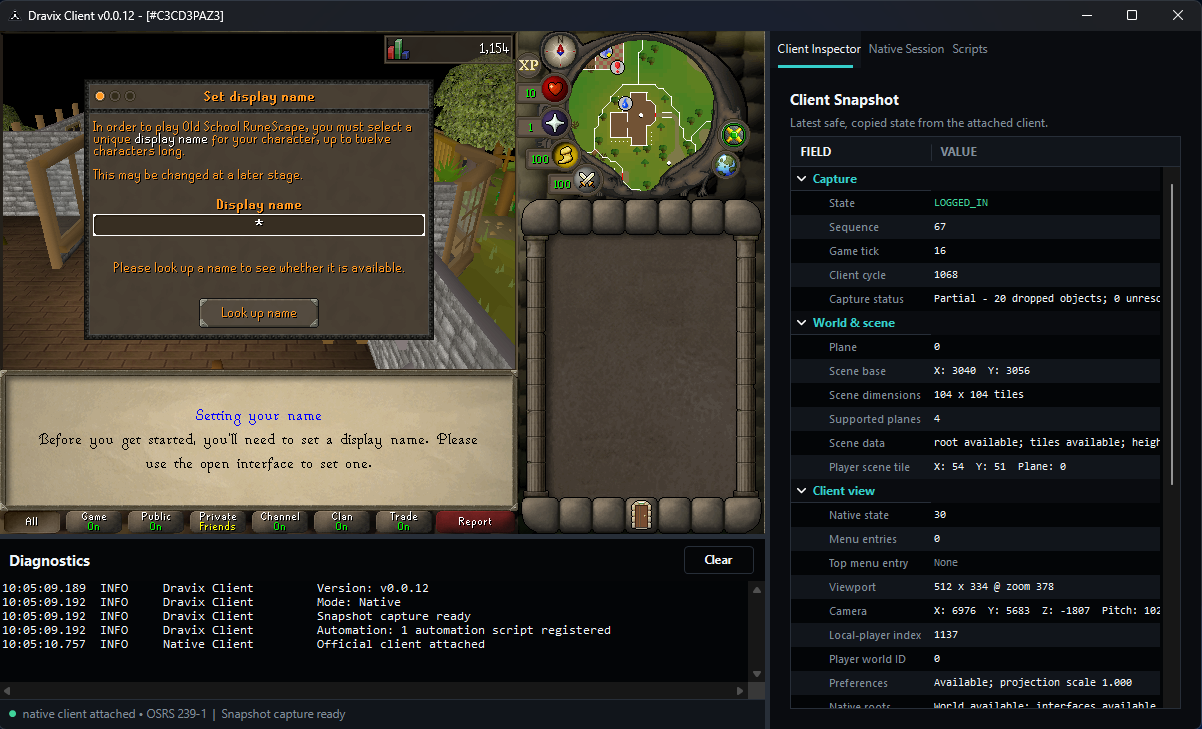
Automation does not construct, modify, or dispatch game-network packets.
Menu state is validation evidence; Dravix never calls an internal menu function.
Virtual mouse and key messages stay inside the authenticated JagRenderView.
PURPOSE // COMPLETE SYSTEM
From process to behavior.
One owned path from launcher identity to copied state, versioned APIs, verified targets, and observable automation.
01
Persistent Client Hub
A native SWT hub manages DPAPI-protected Jagex profiles, selectable characters, recent activity, and multiple isolated client processes.
02
Exact build identity
Every supported executable is locked, fully SHA-256 fingerprinted, and resolved through a closed build catalog before any native layout can run.
03
Complete runtime layouts
Roots, offsets, structure shapes, sizes, bounds, projection constants, and native state values live in reviewed, version-owned manifests.
04
Generated build hooks
Approved manifests generate immutable Java layouts. Thin revision bindings connect those values to shared capture and validation algorithms.
05
Copied game state
Bounded external reads become immutable RS snapshots for client, world, scene, actors, NPCs, objects, inventory, camera, viewport, and menu state.
06
Capability-gated runtime
Versioned APIs, opaque capture-scoped references, bounded queues, cancellation, timeouts, and repeated validation keep unavailable work unavailable.
07
Natural virtual mouse
Client-local motion uses cubic curves, minimum-jerk easing, Fitts-style timing, tapered noise, occasional overshoot, and varied click holds.
08
Verified interaction
Targets, slots, menu evidence, viewport geometry, process identity, capture sequence, and cancellation are rechecked immediately before input.
REVISION RESILIENCE // TOOLING
Built for the future.
Game updates are expected. Dravix treats every revision as a new, reviewable binding instead of carrying old offsets forward on trust.
READ-ONLY // REVIEW-FIRST // FAIL-CLOSEDOFFSET + HOOK DEVELOPMENT TOOLCHAIN
01FINGERPRINTExact PE + SHA-256
→02MAPRoots + fields + values
→03GENERATEImmutable typed layout
→04BINDCapabilities + gates
01DISCOVER
Fingerprint and map.
The native revision mapper fingerprints PE identity and sections, then compares normalized x64 instruction contexts for global RVAs, member displacements, and constants.
02REVIEW
Keep uncertainty visible.
Candidate workspaces rank evidence as high-confidence, review, ambiguous, or unmatched. No candidate is treated as a validated hook.
03GENERATE
Compile reviewed layouts.
Approved JSON produces immutable typed layouts at build time. The installed client never downloads offsets or parses editable layout JSON at runtime.
04PROMOTE
Bind only after evidence.
Synthetic, structural, live read-only, interaction, catalog, and shutdown gates must pass before a revision and its capabilities enter the client.
UNKNOWN BUILD // REJECTED
The shipping client uses a closed catalog of approved layouts. It does not download executable code, offsets, or configuration. A malformed hash, mismatched descriptor, incomplete manifest, or unvalidated capability is rejected before an address formula or action path can run.
MEMORY TO MODEL // CURRENT BOUNDARY
Hooks that
prove themselves.
A hook is not just an offset. It is a revision-specific route from native memory to a validated semantic value, copied into a stable public model with explicit availability and failure behavior.
HOOK FAMILYSYSTEMSTATUS
01Build identityRegistry Bound
WHY IT MATTERSA native layout is meaningful only for the exact executable it was derived and validated against.
CURRENT CONTRACTOSRS 239-1 resolves through a full SHA-256 descriptor whose binding ID, Game API, capabilities, and generated layout identity must agree.
02Client and captureSnapshot Bound
WHY IT MATTERSGame state, native state, cycle, tick, sequence, and capture quality define one coherent moment for every consumer.
CURRENT CONTRACTThe backend rereads stability fields and marks changed, missing, or malformed data partial instead of manufacturing authoritative values.
03World and sceneWorld view Bound
WHY IT MATTERSPlane, scene base, dimensions, tile roots, terrain heights, and render flags anchor every position and scene query.
CURRENT CONTRACTRSWorldViewSnapshot exposes safe copied values and availability only; native pointers and revision offsets never leave the backend.
04Local actorRSActor Bound
WHY IT MATTERSMovement, animation, orientation, size, waypoints, position, and facing are the base signals for future behavior state machines.
CURRENT CONTRACTThe local player is published as capture-coherent RSActor state with typed fine, world, and scene coordinates.
05NPC tableNPCS_V1 Read-only
WHY IT MATTERSNPC definition identity and full shared actor state are required before combat targeting can be reasoned about safely.
CURRENT BOUNDARYNPCs are mapped and queryable. NPC action references remain absent until exact target validation and the dedicated input path pass live gates.
06Game objectsEntities Input V1
WHY IT MATTERSObjects connect copied scene state to a verified visible target without calling an internal game action.
CURRENT CONTRACTThe supported default option is revalidated through object identity, projection, picked-list evidence, and an exact same-cycle menu tuple before a virtual click.
07InventoryContainers Drop V1
WHY IT MATTERSA complete 28-slot snapshot supports exact item identity, quantity, action slots, and future inventory behaviors.
CURRENT BOUNDARYExact Shift-Drop is implemented with live slot, component, menu, and modifier cleanup checks; logged-in acceptance remains an explicit release gate.
08Client viewProjection Bound
WHY IT MATTERSViewport, zoom, camera, menu entries, local-player index, world ID, preferences, and roots connect state to the rendered client surface.
CURRENT CONTRACTRSClientViewSnapshot publishes copied values and safe availability while keeping pointer-backed internals private.
09Next systemsRoadmap Planned
WHY IT MATTERSSkills, settings, destination, collision, banking, ground items, combat evidence, and validated NPC input unlock useful long-running behaviors.
FAIL-CLOSED RULEPublic facades may exist ahead of a native family, but the capability is not advertised and requests return unsupported until mapping and acceptance are complete.
INTERACTION // VIRTUAL POINTER
Human-shaped motion.
Machine-checked intent.
Dravix implements a NaturalMouse-style virtual pointer inside the attached client: cubic paths, minimum-jerk easing, Fitts-style duration, tapered noise, optional overshoot and correction, and varied button holds. The Windows desktop cursor is never moved.
Motion alone is never authority. Game-object and inventory paths revalidate the exact target, action text, slot, component, viewport, render window, process identity, and capture sequence before emitting client-local mouse or key messages. NPC state is already mapped read-only; NPC clicking stays disabled until its separate action-validation path is proven.
CURVED TRAJECTORYLIVE TARGET REVALIDATIONDESKTOP CURSOR UNTOUCHED
ROADMAP // VERIFIED VERTICAL SLICES
Build forward without guessing.
Next mappings include player identity, NPC action validation, health and combat evidence, destination and collision, skills and settings, ground items, equipment, and banking. Woodcutting and Combat arrive as bounded, replay-tested behaviors built above the same public API.
 REVISION READY